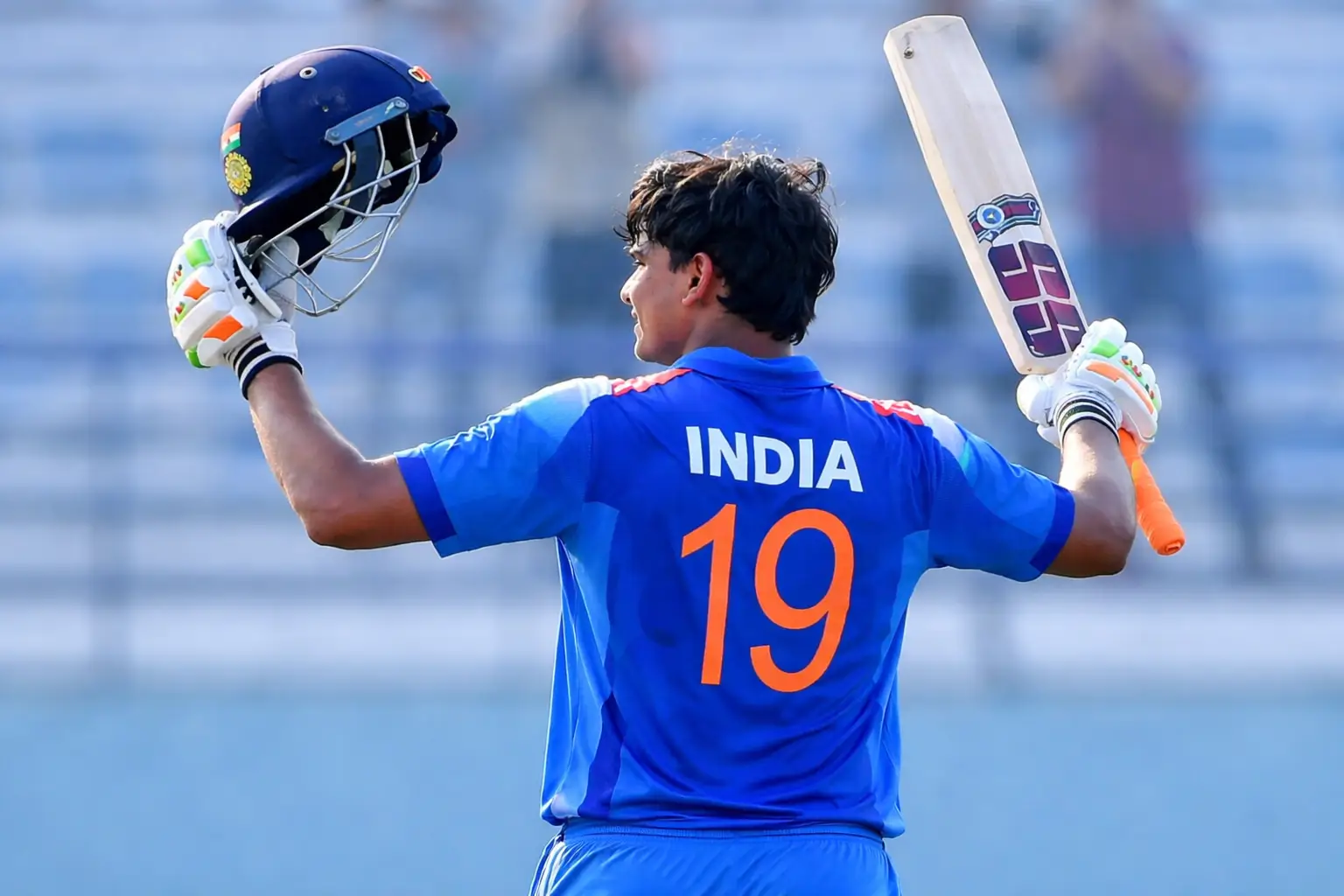
India Under-19 secured a place in the semi-finals of the Under-19 World Cup with a 58-run victory over Pakistan Under-19 in their final Super Six match. The result confirmed India as group leaders, while Pakistan were knocked out of the tournament after failing to meet the qualification requirements in both points and net run rate.
The match, played on a surface that became increasingly difficult for batting as the day progressed, highlighted India’s depth and tactical clarity. Pakistan, despite early advantages in both innings, were unable to convert key moments into sustained pressure or a winning position.
Match Summary
- India Under-19: 252 all out
(Vedant Trivedi 68, Kanishk Chouhan 35, RS Ambrish 29; Subhan 3/33) - Pakistan Under-19: 194 all out
(Usman Khan 66, Zahoor Ahmed 42; Ayush Mhatre 3/21, Khilan Patel 3/35) - Result: India Under-19 won by 58 runs
Context Before the Match
Going into the game, the stakes were clear for both sides. India needed a win to finish at the top of the Super Six group and secure a semi-final clash against Afghanistan in Harare. A loss, particularly after 33.3 overs, would have placed them second and set up a more demanding semi-final against Australia on a used surface in Bulawayo.
Pakistan’s task was more complicated. They needed not just a win but a win of sufficient speed to overturn India’s advantage in net run rate. This required chasing a target of 253 runs within 33.3 overs—an aggressive ask on a pitch known for variable bounce and increasing turn.
India’s Innings: Recovery Through Depth
India’s innings did not begin smoothly. Pakistan’s new-ball bowlers applied early pressure, reducing India to 47 for 3 within the first powerplay. The early wickets gave Pakistan control and suggested that India could be restricted to a modest total.
However, Vedant Trivedi played a stabilizing role. Batting with composure, Trivedi scored 68 runs from 98 balls, focusing on strike rotation rather than boundary-hitting. His partnership with Vihaan Malhotra helped India recover from the early setback and ensured the innings did not collapse.
As wickets continued to fall, India’s lower middle order and tail contributed valuable runs. Kanishk Chouhan, batting at No. 8, scored an important 35 runs. RS Ambrish added 29, while Khilan Patel provided late momentum with a quick 21 off 15 balls.
Pakistan had India under pressure again at 200 for 7, but they could not finish the innings strongly. Slow fielding and lapses in discipline allowed India to score freely at the end. Due to over-rate issues, Pakistan were required to bowl the final four overs with an extra fielder inside the 30-yard circle. India took advantage, scoring 39 runs in those overs, pushing the total beyond 250.
This late surge proved decisive, turning a competitive score into a challenging one on a deteriorating pitch.
Pakistan’s Chase: A Missed Opportunity
In Under-19 World Cup Pakistan began their chase positively. The openers showed intent, and the early overs suggested they might attempt the required aggressive approach. However, as the innings progressed, their strategy appeared more conservative than the situation demanded.
Despite needing to chase the target in 33.3 overs, Pakistan did not consistently take risks. By the halfway stage, they were well placed for a conventional chase but falling behind the rate required for qualification.
The pitch, which initially allowed stroke play, became slower and offered more turn as the afternoon wore on. India’s bowlers adjusted quickly, relying heavily on spin and defensive fields to restrict scoring opportunities.
At 151 for 3 in 29.4 overs, Pakistan still had a chance to push for a strong finish. However, the dismissal of captain Farhan Yousaf marked a turning point. Attempting to clear long-on against a slower delivery, Yousaf was caught, triggering a collapse.
From that point, Pakistan lost eight wickets for just 43 runs. The batting struggled against spin, and shot selection became increasingly cautious or reactive rather than planned.
India’s Bowling: Control and Variety
India’s bowling attack was built around adaptability rather than pace or aggression. The spinners, including part-time options, extracted significant assistance from the surface.
Ayush Mhatre, leading the side, claimed three wickets while maintaining tight control over the scoring rate. Khilan Patel supported with three wickets of his own, completing a strong all-round performance after his late runs with the bat.
Kanishk Chouhan, who began bowling early in the innings, finished with figures of 10-1-30-1. His ability to bowl defensively without conceding boundaries helped build pressure from one end while wickets fell at the other.
India’s use of spin against a left-hand-dominated batting lineup proved effective. The ball turned sharply, and batters found it difficult to play through the line or score freely in the middle overs.
Fielding Moments and Missed Chances: Under-19 World Cup
One of the notable moments of the match came early in India’s innings when Vaibhav Suryavanshi received two lifelines on the same delivery. Attempting an aerial shot, Suryavanshi miscued the ball, but the catch was dropped. A quick throw toward the wicketkeeper’s end followed, but the ball was not gathered cleanly, allowing him to return safely to his crease.
Although Suryavanshi was eventually dismissed for 30 off 22 balls, the incident highlighted Pakistan’s fielding struggles. Such missed opportunities added pressure on the bowlers and allowed India to maintain momentum during critical phases.
Tactical Contrast Between the Teams
The match underlined a clear contrast in approach. India focused on securing qualification first, adjusting their tactics to the conditions and game situation. With the ball, they bowled defensively early, accepting singles while waiting for batters to take risks. Once the opportunity arose, they tightened the field and struck quickly.
Pakistan, by contrast, appeared caught between strategies. Their intent against the new ball was present but not sustained. Even when the required rate demanded a more aggressive approach, they largely took what was offered rather than forcing the issue.
This indecision was evident at 13.3 overs, when Pakistan needed 174 runs from 20 overs with nine wickets in hand to qualify. The situation required a shift to a high-risk, high-reward approach, but it never materialized.
Key Performers Under-19 World Cup
- Vedant Trivedi (India): Anchored the innings under pressure with a patient 68, setting the foundation for a competitive total.
- Ayush Mhatre (India): Led effectively, contributing with the ball and making timely tactical decisions.
- Usman Khan (Pakistan): Top-scored with 66 and was part of a promising third-wicket partnership.
- Khilan Patel (India): Contributed in both innings, scoring late runs and taking three wickets.
What the Result Means
With this win, India Under-19 finished as group leaders in the Super Six stage. They advanced to the semi-finals with confidence, having demonstrated adaptability across different conditions.
Pakistan Under-19, meanwhile, exited the tournament without qualifying for the semi-finals and without registering a win against India in this edition. The campaign will prompt reflection on fielding standards, tactical clarity, and middle-order depth.
Overall Tournament Update: Under-19 World Cup
As the Under-19 World Cup moves into the knockout phase, the competition remains open. India will face Afghanistan in the semi-final in Harare, a matchup that brings together India’s depth and Afghanistan’s growing reputation for disciplined bowling and fearless batting.
Australia and the remaining semi-finalists continue to pose strong challenges, particularly on pitches that have shown increasing wear. Spin is expected to play a decisive role in the latter stages of the tournament.
So far, the tournament has highlighted the importance of adaptability, fielding efficiency, and decision-making under pressure. Teams that have read conditions well and adjusted their strategies accordingly have gained a clear advantage.
With the semi-finals approaching, consistency and composure will be key. India’s performance against Pakistan suggests they are well-prepared for the challenges ahead, while Pakistan’s exit underscores how fine margins and missed opportunities can define a campaign at this level.
Disclaimer
The information in this article is based on verified match data and publicly available records related to the Under-19 World Cup. It is presented solely for informational purposes.