
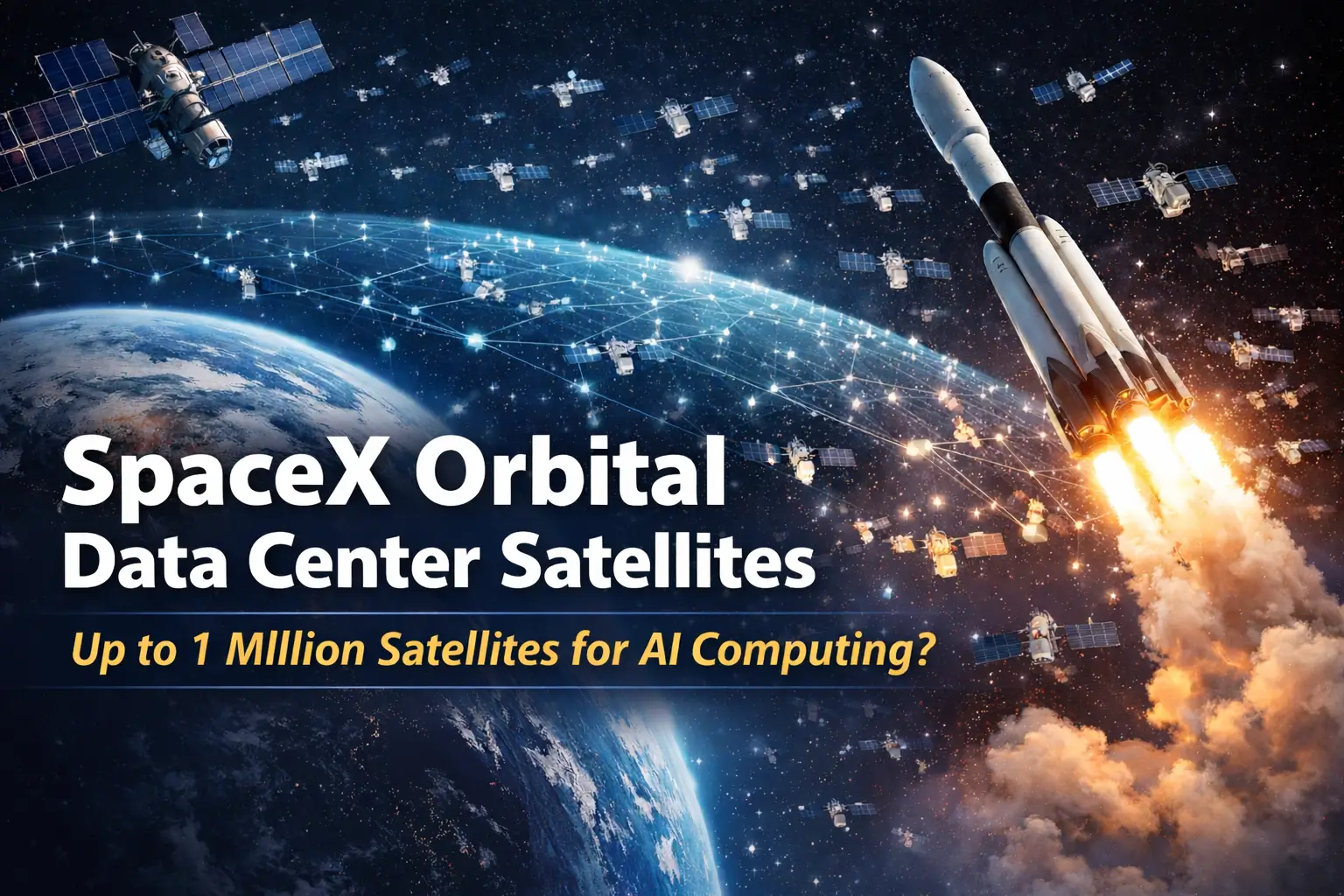
SpaceX has submitted a formal application to the Federal Communications Commission (FCC) seeking permission to deploy up to one million solar-powered satellites in low-Earth orbit.
According to the application, these satellites would function as “orbital data centers”, designed to handle high-intensity computing tasks, especially those related to artificial intelligence (AI).
This filing is real and confirmed by multiple reputable news organisations.
However, it is important to understand that this is only a regulatory request, not an approval or a confirmed launch plan.
- 1. What SpaceX has officially requested
- 2. Why SpaceX believes orbital data centers are useful
- 3. How the orbital data-center satellites may work
- 4. The role of Starship and launch economicsSpaceX’s plan strongly depends on lower launch costs, which are expected to come from its next-generation rocket, Starship.
- 5. Technical and scientific concerns raised by experts
- 6. Regulatory and geopolitical considerations
- You May Like
1. What SpaceX has officially requested
SpaceX has asked the FCC for authorization to operate a very large non-geostationary satellite system.
The application sets an upper limit of approximately one million satellites, meaning this is the maximum number requested, not a guaranteed deployment figure.
In its documentation, SpaceX describes these satellites as:
- Small, computer-equipped spacecraft
- Powered mainly by solar energy
- Capable of processing and storing data
- Connected to each other through advanced communication links
- Operating in low-Earth orbit, roughly 500 to 2,000 kilometres above Earth
SpaceX states that placing computing systems in orbit could provide more consistent solar power compared to many ground-based facilities.
Important legal clarification
Regulatory filings of this kind are common in the space industry. Experts note that companies often request large limits to maintain future flexibility. The FCC may approve, partially approve, modify, or reject the proposal after detailed review.
2. Why SpaceX believes orbital data centers are useful
According to SpaceX’s application and public explanations, orbital data centers could offer several potential advantages for certain computing tasks:
Continuous solar energy
Satellites in low-Earth orbit can receive sunlight for longer periods than many locations on Earth. SpaceX argues this could provide a steady power source for computing systems.
Reduced dependence on water
Traditional data centers on Earth often require large amounts of water for cooling. SpaceX suggests that space-based systems could rely more on radiative cooling methods, reducing water usage.
Global computing access
A large satellite network could distribute computing resources across the globe, potentially allowing data processing closer to end users.
Scalability over time
SpaceX indicates that if launch costs decrease significantly, space-based computing capacity could be expanded gradually to meet growing AI demand.
Industry analysts emphasize that these are claims made by SpaceX, and their real-world effectiveness would depend on engineering success and economic feasibility.
3. How the orbital data-center satellites may work
SpaceX has not published a complete technical blueprint, but information from the filing and expert analysis suggests several key design features:
- Modular satellite design, allowing mass production
- Solar panels sized to support computing and communications
- Laser-based inter-satellite links, enabling fast data transfer without relying entirely on ground stations
- Specialized computing hardware, likely designed for AI workloads
- Radiation-tolerant systems, necessary for operating in space
- Autonomous software, capable of managing workloads, failures, and routing data across the network
Together, these components would form a distributed computing network in orbit, where tasks could be shared among many satellites.
Experts caution that payload weight, power limits, cooling efficiency, and long-term reliability are critical challenges that will determine how capable such systems can be.
4. The role of Starship and launch economicsSpaceX’s plan strongly depends on lower launch costs, which are expected to come from its next-generation rocket, Starship.
According to industry observers:
- For orbital computing to compete with ground data centers, launch costs must drop significantly
- Fully reusable rockets like Starship are central to this strategy
- Even with cheaper launches, manufacturing, deploying, replacing, and operating large numbers of satellites would require enormous investment
Experts also point out that SpaceX has previously requested large satellite limits for its Starlink network, while deploying satellites in phases rather than all at once.
5. Technical and scientific concerns raised by experts
a) Cooling and heat management
Specialists note that removing heat in space is more complex than on Earth. High-performance computing chips generate significant heat, and cooling them without heavy equipment is a major engineering challenge.
b) Radiation exposure
Satellites in low-Earth orbit are exposed to solar radiation and charged particles. Experts say this increases the need for hardened electronics and redundancy, which can raise costs and satellite weight.
c) Space debris and collision risk
Space safety experts warn that adding very large numbers of satellites increases the risk of collisions. Such events can create debris that threatens other spacecraft, a scenario often discussed in orbital safety research.
d) Impact on astronomy
Astronomers have previously reported that satellite constellations can interfere with telescope observations, both visually and through radio signals. Scientists state that a much larger number of satellites would require stricter coordination and mitigation measures.
6. Regulatory and geopolitical considerations
Federal Communications Commission (FCC) oversight
The Federal Communications Commission (FCC) will examine issues such as spectrum usage, satellite spacing, collision-avoidance systems, and de-orbit plans. Approval, if granted, would likely include strict operational conditions.
International coordination
Low-Earth orbit is shared globally. Experts highlight that international cooperation through organisations like the ITU is necessary to manage spectrum and orbital traffic fairly.
Environmental evaluation
While SpaceX presents orbital data centers as potentially more energy-efficient, experts stress that full environmental assessments must include satellite manufacturing, launches, and replacements.
7. Is one million satellites realistic?
Most analysts view one million satellites in SpaceX’s filing should be understood as a maximum regulatory request, not an immediate deployment goal. Experts say it is common for companies to ask for high limits in applications so they are not constrained if their systems expand in the future.
Looking at past satellite projects, specialists note that very large constellations are usually introduced step by step, not all at once. The final number of satellites deployed typically depends on several factors, including commercial demand, launch affordability, technical readiness, and regulatory permissions. Analysts broadly agree that even if approval is granted, any deployment would most likely take place gradually over an extended period.
8. Public and scientific response
As satellite activity in low-Earth orbit increases, scientists and policy groups have raised calls for greater operational transparency. Astronomers, in particular, have highlighted the need for better coordination to limit interference with optical and radio-based observations.
Space policy experts also underline the importance of strong space debris management plans, including effective collision avoidance systems and reliable procedures for removing satellites at the end of their operational life. According to analysts, regulators will be expected to weigh innovation against broader responsibilities such as orbital safety, environmental considerations, and the protection of scientific research.
9. Industry context and competition
Experts point out that SpaceX is part of a broader trend, rather than acting alone. Reports indicate that other private-sector companies are exploring space-based computing concepts, while several governments, including China, are examining similar technologies for future use.
At the same time, analysts observe that ground-based cloud computing providers continue to invest heavily in improving data center efficiency, cooling methods, and AI-focused hardware. Specialists note that for orbital computing to gain traction, it would need to demonstrate practical benefits that clearly distinguish it from advanced Earth-based infrastructure.
10. What happens next
In the short term, experts expect regulators to begin a detailed review of SpaceX’s application. This process typically includes public feedback, technical assessments, and requests for additional clarification from the applicant.
Over the medium term, analysts suggest that small-scale tests or demonstration missions could occur if regulatory and technical conditions allow. Such efforts would help determine whether orbital data-center concepts can function as intended.
In the long term, specialists widely agree that large-scale orbital data centers would only become feasible if technical performance, economic viability, and regulatory approval align. Even under favorable conditions, experts emphasize that deployment would likely remain controlled and incremental.
Final summary
SpaceX has formally submitted a proposal to deploy up to one million orbital data-center satellites. The filing is confirmed and legitimate, but it has not yet received regulatory approval. Experts stress that the stated number represents a maximum allowance requested, not a confirmed rollout plan.
Analysts across the space and technology sectors point to major technical, regulatory, and safety challenges that must be addressed before any large-scale deployment can occur. Based on expert assessments and past industry experience, any future expansion would almost certainly proceed in stages and under close regulatory oversight.