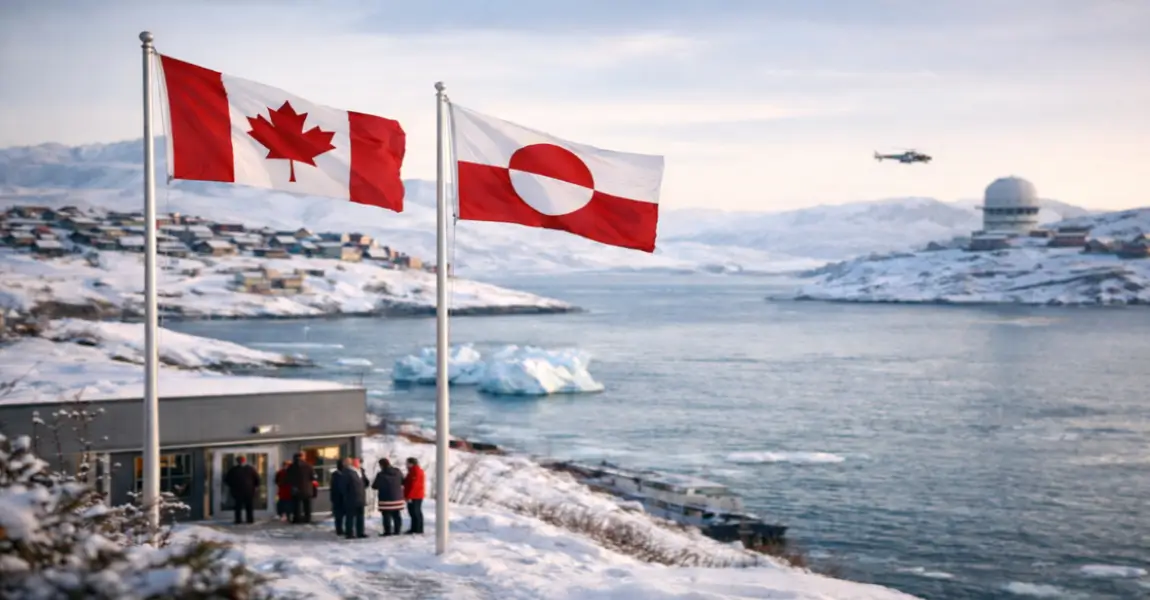
On a clear winter morning in Nuuk, the capital of Greenland, a small but meaningful ceremony marked a larger shift in Arctic diplomacy. On February 6, 2026, Canada Opens Consulate in Greenland, formally establishing its first permanent diplomatic mission on the island
- A Ceremony That Reflected More Than Protocol
- Why the Arctic Is Drawing New Attention
- Greenland’s Strategic Importance in Historical Context
- Geopolitics Beneath the Ice
- How Greenland Sees the New Consulates
- International Reactions from World Leaders
- What Comes Next for the High North
- A Quiet but Significant Shift
- You may like
The moment carried symbolism and strategy in equal measure. Standing by the harbor, Anita Anand joined Greenlandic leaders and officials from Denmark as the Canadian flag was raised. At nearly the same time, France announced it was opening its own consulate in Nuuk, becoming the first European Union country to establish a permanent diplomatic presence there.
For a place long viewed as remote, Nuuk is now firmly at the center of global attention.
A Ceremony That Reflected More Than Protocol
The opening ceremony was modest but deliberate. Canadian officials described the consulate as a working mission rather than a symbolic outpost. Speeches focused on cooperation in climate science, environmental monitoring, Arctic safety, and regional stability.
Greenland’s government, the Naalakkersuisut, welcomed the move as recognition of Greenland’s growing international role. Danish representatives echoed that message, emphasizing partnership rather than competition. France’s parallel announcement reinforced the sense that Western allies are reassessing how they engage with the Arctic, not as a distant frontier, but as a region shaping global outcomes.
Why the Arctic Is Drawing New Attention
The reasons behind these diplomatic moves are rooted in climate and geography. The Arctic is warming more than twice as fast as the global average. Melting ice is altering coastlines, opening new shipping routes, and exposing mineral resources once locked beneath ice and permafrost.
For Canada, an Arctic nation with the world’s longest Arctic coastline, these changes carry direct consequences. Opening a consulate in Nuuk brings Canadian diplomats closer to Greenlandic decision-makers at a time when scientific research, search-and-rescue coordination, and environmental policy are becoming more urgent.
France’s interest is different but complementary. While not an Arctic state, France has a long history in polar research and plays an active role in international climate science. A permanent diplomatic mission provides a platform to support scientific cooperation and policy dialogue.
Greenland’s Strategic Importance in Historical Context
Policy & Diplomacy Focused
Foreign interest in Greenland has developed over decades, shaped by geography, security concerns, and evolving political authority on the island. One of the earliest and most cited examples came in 1946, when the United States proposed purchasing Greenland from Denmark. The proposal was rejected, but it underscored Greenland’s strategic value during the early Cold War, particularly for transatlantic defense and Arctic monitoring.
Over time, Greenland’s political status changed in ways that reshaped how foreign governments engage with the island. In 1979, Greenland achieved home rule, allowing greater control over domestic affairs. This was followed by the 2009 Self-Government Act, which expanded Greenlandic authority over natural resources and strengthened its right to pursue greater autonomy in the future. These changes marked a shift from external decision-making toward local governance.
As a result, diplomacy involving Greenland now requires direct engagement with its capital, Nuuk, rather than relying solely on Copenhagen. This shift became especially visible in 2019, when a renewed public suggestion from a U.S. administration to purchase Greenland drew firm responses from both Greenlandic and Danish leaders. Greenland’s government stated clearly that the island was not for sale, reinforcing its political agency and right to self-determination.
Today, new diplomatic missions in Nuuk reflect this evolution. Modern consulates are not viewed as tools of control, but as formal channels for cooperation with a government that increasingly represents its own interests. They acknowledge Greenland’s role as a political actor in Arctic affairs, climate research, and regional governance.
Greenland’s strategic importance remains tied to its location and resources, but its voice in shaping international relationships has grown. The balance between global interest and local authority continues to define Greenland’s position in a changing Arctic.
Geopolitics Beneath the Ice
The timing of the Canadian and French moves also reflects broader geopolitical currents. Russia has expanded military infrastructure across its Arctic territory. China has described itself as a “near-Arctic state” and invested heavily in polar research and infrastructure.
Western allies are responding by strengthening coordination and presence, emphasizing transparency and cooperation. For Canada, a mission in Nuuk supports North Atlantic security interests, including maritime awareness and emergency response. For France, it aligns with commitments to allies and multilateral Arctic governance.
These actions suggest a quiet but deliberate effort to ensure that the Arctic’s future is shaped through diplomacy rather than rivalry.
How Greenland Sees the New Consulates
Greenland’s leaders have welcomed the new missions, but public discussion on the island remains cautious. Economic opportunities from foreign investment and research funding are balanced against concerns about environmental protection and cultural preservation.
Greenland’s government has consistently stressed that partnerships must respect local priorities. Climate research, education, and capacity-building are viewed more favorably than extractive projects without long-term benefits for communities.
Denmark has also supported the consulates, noting that they align with Greenland’s self-governing status while reinforcing cooperation within the Kingdom.
International Reactions from World Leaders
The decision by Canada to open a consulate in Nuuk has drawn measured but notable reactions from political leaders and officials across the Arctic and beyond. While responses have largely avoided dramatic language, they underline how closely governments are watching developments in Greenland and the wider Arctic region.
Canadian officials framed the move as a practical step rather than a geopolitical signal. Foreign Minister Anita Anand described the consulate as a way to strengthen cooperation on climate research, Arctic safety, and engagement with Greenland’s institutions. Ottawa emphasized that the mission is focused on partnership and presence, not competition.
In Copenhagen, Danish leaders welcomed the development. Officials from the government of Denmark said Canada’s presence complements existing cooperation within the Kingdom of Denmark and respects Greenland’s self-governing status. Danish statements highlighted stability and coordination among allies rather than strategic rivalry.
Greenland’s leadership responded cautiously but positively. Representatives of the Naalakkersuisut said the consulate reflects growing international recognition of Greenland’s role in Arctic affairs. At the same time, they reiterated that foreign engagement must align with local priorities, particularly environmental protection and long-term benefits for Greenlandic communities.
France’s announcement of its own consulate prompted attention in European policy circles. French officials noted that the move reflects France’s long-standing involvement in polar science and multilateral governance. The emphasis, according to Paris, is on research cooperation and diplomatic dialogue rather than security competition.
Elsewhere, reactions were more indirect. U.S. officials did not issue formal statements but signaled continued interest in Arctic cooperation through existing channels. Analysts also noted that Russia and China are likely monitoring the developments closely, given their expanding activities in the Arctic, even if they have not publicly commented.
Overall, international reactions suggest broad acceptance of Canada’s move as part of a gradual, coordinated shift in Arctic diplomacy rather than a sudden escalation.
What Comes Next for the High North
The presence of new consulates in Nuuk is likely to draw further attention. Other countries with Arctic interests may seek stronger ties, whether through diplomatic missions or scientific agreements.
Research collaboration is expected to grow as scientists study melting ice sheets, rising sea levels, and changing ecosystems. Economic discussions, particularly around critical minerals and sustainable development, will follow. At the same time, practical cooperation on search and rescue will become increasingly important as Arctic waters see more traffic.
A Quiet but Significant Shift
When Canada Opens Consulate in Greenland, it signals more than a new address on a diplomatic registry. It reflects an Arctic that is no longer distant from global affairs and a Greenland that is increasingly central to conversations about climate, security, and governance.
The flags raised in Nuuk represent dialogue rather than dominance. They mark a future where cooperation, respect, and shared responsibility will determine how the Arctic navigates a warming world.
For Greenland, the attention brings both opportunity and responsibility. For Canada and its allies, it underscores a recognition that the high North is no longer at the margins of international strategy, but firmly within it.
Disclaimer
This article is based on publicly available information, historical records, and official statements available at the time of writing. While every effort has been made to ensure accuracy, some details may evolve as governments release new information. Readers are advised to consult official sources for the latest updates.