
Introduction: AI Is Already Part of Your Daily Life
Artificial Intelligence is no longer a futuristic idea. It is already part of everyday life. From voice assistants and recommendation systems to self-driving cars and advanced medical tools, AI is shaping how people live and work.
Many people ask simple but important questions. What is Artificial Intelligence? How does it actually work? Will AI replace human jobs? Is it safe? These concerns are valid. AI is powerful, and any powerful technology brings both opportunities and risks.
- Introduction: AI Is Already Part of Your Daily Life
- What Is Artificial Intelligence?
- A Brief History of Artificial Intelligence
- How Artificial Intelligence Actually Works
- Types of Artificial Intelligence
- Real-World Applications of Artificial Intelligence
- Benefits of Artificial Intelligence
- Risks and Challenges of Artificial Intelligence
- The Future of Artificial Intelligence
- Frequently Asked Questions (FAQ)
- Conclusion
- You May Like
- OpenAI Launches Codex App for macOS to Manage Multiple AI Coding Agents
Understanding Artificial Intelligence is important in 2026 because it affects education, healthcare, finance, communication, and almost every industry. This guide explains AI in simple language. No heavy math. No complex technical jargon. Just clear facts and practical examples.
By the end of this article, you will understand what Artificial Intelligence is, how it works, the different types, real-world uses, risks, and what the future may look like.
What Is Artificial Intelligence?
Artificial Intelligence, often called AI, refers to machines or software that can perform tasks that normally require human intelligence.
These tasks include:
- Learning from data
- Solving problems
- Recognizing speech and images
- Making decisions
- Understanding language
In simple terms, AI allows computers to “think” in a limited way.
Human Intelligence vs Machine Intelligence
Human intelligence involves reasoning, emotions, creativity, and common sense. Humans learn from experiences and adapt naturally.
Machine intelligence, on the other hand, depends on data and algorithms. AI systems do not have emotions or consciousness. They follow programmed instructions and patterns learned from data.
For example:
- A human recognizes a dog by experience.
- An AI system recognizes a dog after analyzing thousands of labeled images.
AI does not understand like humans. It predicts and responds based on patterns.
Narrow AI vs General AI
There are two main categories:
Narrow AI (Weak AI)
This is the most common form today. It performs one specific task very well. Examples include:
- Voice assistants
- Recommendation systems
- Spam filters
General AI (Strong AI)
This refers to machines that can perform any intellectual task a human can do. General AI does not yet exist. It remains a research goal.
Most AI systems today fall under Narrow AI.
A Brief History of Artificial Intelligence
AI did not appear overnight. It has developed over decades.
1956: The Dartmouth Conference
The term “Artificial Intelligence” was officially introduced at a conference at Dartmouth College in 1956. Researchers believed machines could simulate human intelligence.
The AI Winters
In the 1970s and late 1980s, AI research slowed down due to lack of computing power and limited results. These periods are known as “AI winters.”
Machine Learning Boom (2000–2015)
With faster computers, large datasets, and improved algorithms, AI research accelerated. Machine learning became more effective.
Modern AI Era (2020+)
Since 2020, AI tools such as language models, image generators, and advanced automation systems have become mainstream. Businesses, schools, and governments now use AI technologies daily.
How Artificial Intelligence Actually Works
Understanding how Artificial Intelligence works can seem complex. However, the core principle is straightforward. AI systems examine information, detect patterns, and use those patterns to make decisions or predictions.
Unlike humans, AI does not understand meaning in an emotional or conscious way. It calculates probabilities based on previous data. The strength of an AI system depends on how well it has been trained and how much relevant data it has processed.
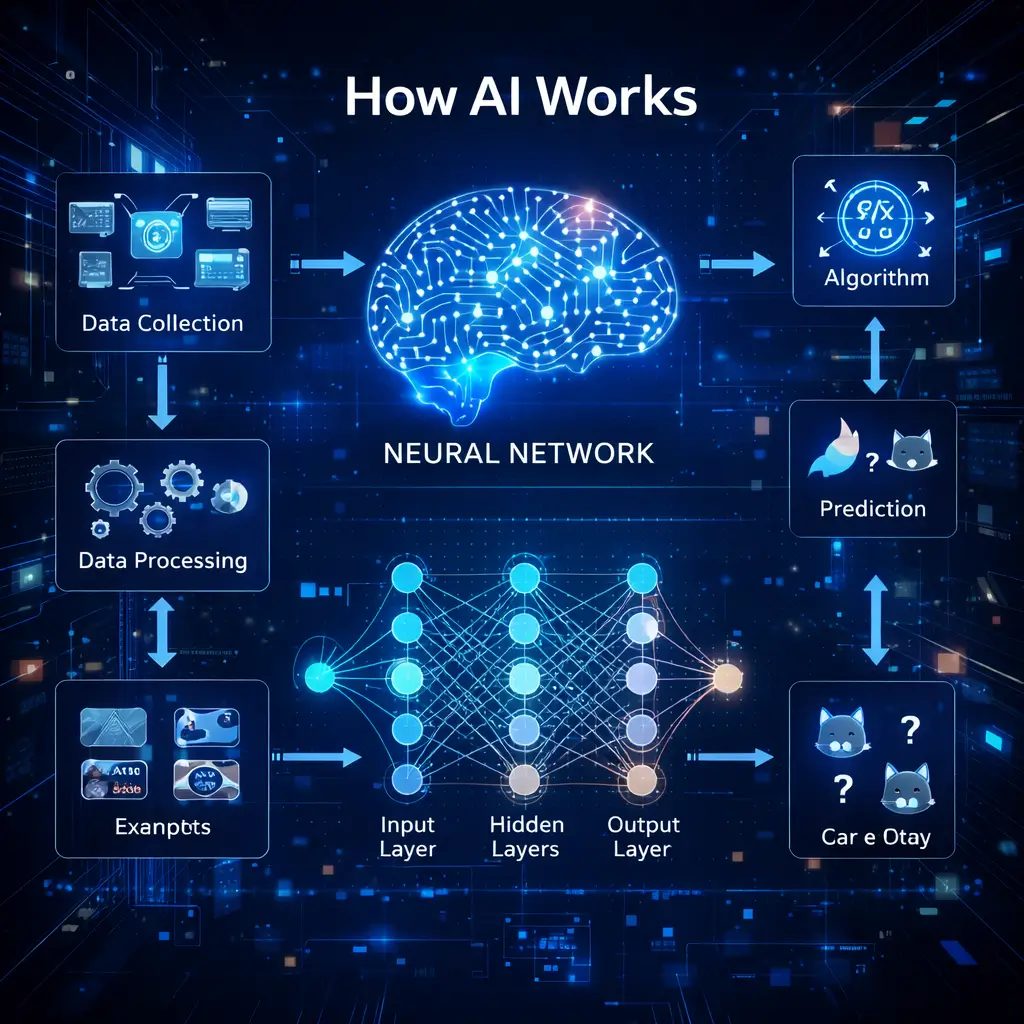
Below is a clear and structured breakdown of the process.
Step 1: Data
Data is the foundation of every AI system. Without data, Artificial Intelligence cannot function.
Data can come from many sources:
- Images
- Written text
- Audio recordings
- Transaction records
- Sensor readings
- Online user activity
For example, if a company wants to create an AI tool that detects fake reviews, it must collect thousands of examples of both genuine and fake reviews. The system studies these examples to identify patterns.
High-quality data improves accuracy. Poor or biased data can lead to incorrect results. This is why data collection and validation are critical steps in AI development.
Step 2: Algorithms
An algorithm is a structured set of instructions that guides how data is processed.
In Artificial Intelligence, algorithms are designed to:
- Detect relationships in data
- Classify information
- Calculate probabilities
- Produce predictions
Different tasks require different algorithm designs. A system that translates languages uses different methods compared to a system that predicts stock market trends.
Algorithms act as the decision-making engine behind AI systems. They define how the system learns and responds.
Step 3: Machine Learning
Machine Learning is one of the most important branches of Artificial Intelligence. Instead of programming every possible rule manually, developers allow the system to learn from examples.
The process works like this:
- Provide training data
- Allow the model to analyze patterns
- Adjust internal calculations based on errors
- Improve performance over time
For example:
- Developers provide thousands of labeled photos of animals.
- The system analyzes shapes, textures, and features.
- It builds a pattern model.
- When shown a new image, it predicts whether it matches learned features.
Machine learning systems improve gradually. The more examples they analyze, the better their predictions become.
There are different learning approaches, including:
- Supervised learning (uses labeled data)
- Unsupervised learning (finds patterns independently)
- Reinforcement learning (learns through feedback and rewards)
Each method is used depending on the problem being solved.
Step 4: Neural Networks
Neural networks are computational models inspired by the structure of the human brain. They consist of layers of connected processing units called “nodes.”
A simplified structure looks like this:
Input Layer → Processing Layers → Output Layer
- The input layer receives raw information.
- Processing layers analyze relationships.
- The output layer delivers the final result.
Each connection between nodes carries a numerical value. These values are adjusted during training. Over time, the network becomes better at identifying patterns.
Neural networks are especially effective for complex recognition tasks such as:
- Facial recognition
- Voice assistants
- Language translation
- Medical image analysis
Their layered structure allows them to detect subtle relationships that simpler systems may miss.
Step 5: Deep Learning
Deep Learning is an advanced form of machine learning that uses neural networks with multiple processing layers.
The term “deep” refers to the number of layers used in the model. More layers allow the system to analyze data at different levels of complexity.
For example, in image recognition:
- The first layer may detect edges
- The next layer may identify shapes
- Further layers may recognize objects
- The final layer produces the classification
This layered analysis enables highly accurate systems used in:
- Speech recognition tools
- Real-time language translation
- Image generation systems
- Self-driving vehicle technology
Deep learning models require significant computing power and large datasets. However, they have driven many of the major AI breakthroughs seen in recent years.
Step 6: Continuous Improvement
AI systems do not stop learning after deployment. Many systems continue to improve as they process new data.
When mistakes occur:
- Developers analyze the errors
- Adjust model parameters
- Retrain the system
- Improve accuracy
This ongoing refinement ensures that Artificial Intelligence systems remain effective and adaptable in changing environments.
In summary, Artificial Intelligence works through a structured pipeline:
Data Collection → Algorithm Processing → Model Training → Pattern Recognition → Prediction → Refinement
It is a mathematical and data-driven process. AI does not think independently, but it can process information at a scale and speed that humans cannot match.
Types of Artificial Intelligence
AI can also be classified based on its capabilities.
1. Reactive Machines
These AI systems respond to specific inputs. They do not store memories or learn from past experiences.
Example: Early chess-playing computers.
2. Limited Memory
Most modern AI systems fall into this category. They use past data to improve decisions.
Example:
- Self-driving cars analyze previous driving patterns
- Recommendation systems remember user behavior
3. Theory of Mind (Conceptual)
This type of AI would understand emotions, beliefs, and intentions. It remains theoretical.
4. Self-Aware AI (Theoretical)
This refers to AI with consciousness and self-awareness. It does not exist today and remains speculative.
Real-World Applications of Artificial Intelligence
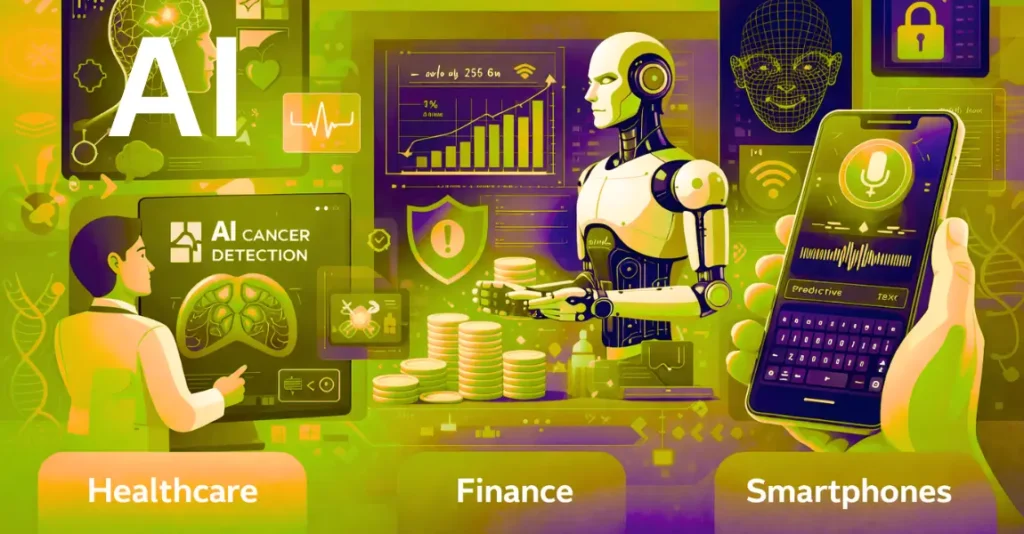
Artificial Intelligence is no longer limited to research labs. It is actively used across industries and affects daily life in practical ways. From hospitals to smartphones, AI systems are improving efficiency, accuracy, and decision-making.
Below are some of the most important real-world applications.
Healthcare
Artificial Intelligence is playing a major role in modern healthcare systems.
AI-powered tools assist doctors in:
- Detecting diseases at early stages
- Analyzing medical scans
- Predicting patient risk levels
- Supporting treatment decisions
For example, AI models can examine thousands of medical images in minutes. They help identify patterns linked to cancer, heart disease, and neurological conditions. This speeds up diagnosis and reduces human error.
AI is also used in drug discovery. Instead of testing thousands of chemical combinations manually, AI systems analyze biological data to predict which compounds may work best. This shortens research timelines.
In hospitals, predictive systems help manage patient flow, schedule surgeries, and reduce waiting times. As healthcare data grows, Artificial Intelligence continues to improve precision and efficiency.
Finance
The financial sector was one of the earliest adopters of AI technology.
Banks and financial institutions use AI for:
- Fraud detection
- Credit risk evaluation
- Algorithmic trading
- Customer service automation
AI systems monitor millions of transactions in real time. If unusual behavior is detected, the system can flag the activity instantly. This reduces financial fraud significantly.
Credit scoring has also improved with AI. Instead of relying only on traditional credit history, AI models analyze broader behavioral data to assess repayment probability.
Investment firms use automated trading systems that analyze market trends faster than human analysts. These systems react within seconds to changing market conditions.
Overall, Artificial Intelligence enhances speed, risk management, and operational efficiency in finance.
Education
Education systems are increasingly integrating AI-based tools.
AI supports learning by:
- Personalizing study materials
- Adapting difficulty levels
- Providing instant feedback
- Automating grading
For example, adaptive learning platforms analyze student performance and adjust lessons accordingly. If a student struggles with a topic, the system provides additional practice. If performance improves, it increases difficulty.
Language translation tools powered by AI help students access global educational resources. Automated grading systems also reduce workload for teachers while maintaining consistency.
Virtual tutors and chat-based learning assistants are becoming more common, offering support outside traditional classroom hours.
Retail and E-Commerce
Retail businesses rely heavily on AI to understand customer behavior.
Common applications include:
- Product recommendations
- Dynamic pricing
- Inventory management
- Demand forecasting
Online platforms analyze browsing history, purchase patterns, and search queries. Based on this data, they suggest products that match user preferences.
AI also predicts demand trends. Retailers can adjust inventory before shortages occur. This improves supply chain efficiency and reduces waste.
Customer service chatbots handle routine queries, providing quick responses without human intervention.
AI in Movies and Entertainment
The entertainment industry uses Artificial Intelligence in both content creation and distribution.
Streaming platforms rely on AI to:
- Recommend personalized content
- Analyze viewer engagement
- Optimize advertising placement
Recommendation engines study viewing habits and suggest movies or shows based on previous choices. This increases user engagement.
In film production, AI tools assist with visual effects, scene enhancement, and post-production editing. Audience analytics also help studios understand viewer preferences before releasing new content.
AI-based content moderation systems detect inappropriate material and maintain platform safety.
AI in Smartphones and Consumer Devices
Modern smartphones depend heavily on Artificial Intelligence.
AI enables:
- Facial recognition security
- Voice assistants
- Real-time language translation
- Smart photography enhancements
- Predictive text input
For instance, smartphone cameras use AI to detect lighting conditions, adjust focus, and enhance image quality automatically. Voice assistants interpret spoken commands and provide accurate responses.
Battery optimization systems also rely on AI to learn usage patterns and extend device performance.
Most users interact with Artificial Intelligence multiple times a day without consciously noticing it.
Transportation and Mobility
AI is also transforming transportation systems.
Applications include:
- Navigation systems
- Traffic prediction
- Autonomous vehicles
- Fleet management
Navigation apps analyze traffic data in real time and suggest faster routes. Logistics companies use AI to optimize delivery schedules and reduce fuel consumption.
While fully autonomous vehicles are still developing, driver-assistance technologies already use AI to improve safety.
Cybersecurity
With increasing digital activity, cybersecurity has become critical.
AI-based systems monitor network traffic and detect unusual behavior. These tools:
- Identify potential cyberattacks
- Detect malware patterns
- Strengthen data protection
AI can respond faster than manual monitoring systems, reducing potential damage from security breaches.
In summary, the real-world applications of Artificial Intelligence are diverse and expanding. It supports industries by improving efficiency, reducing costs, and enhancing decision-making. As technology advances, its integration into everyday systems will likely increase even further.
Benefits of Artificial Intelligence
AI offers many advantages.
Speed
AI processes data faster than humans.
Automation
Repetitive tasks can be automated, increasing efficiency.
Accuracy
AI reduces human errors in tasks like calculations and data analysis.
Large-Scale Data Processing
AI can analyze huge datasets quickly, helping businesses make informed decisions.
Risks and Challenges of Artificial Intelligence
While AI provides benefits, it also raises concerns.
Job Displacement
Automation may reduce demand for certain roles. However, new AI-related jobs are also emerging.
Bias in AI Systems
If training data contains bias, AI systems may produce unfair results.
Privacy Concerns
AI systems often rely on personal data. Protecting user privacy is critical.
AI Ethics
Ethical questions include:
- Who is responsible for AI decisions?
- How should AI be regulated?
- What limits should exist?
Governments worldwide are developing AI regulations to address these concerns.
The Future of Artificial Intelligence

AI development continues rapidly.
AI-Driven Jobs
New roles are emerging:
- AI engineers
- Data scientists
- AI ethics specialists
- Automation experts
Automation Trends
Industries such as manufacturing, logistics, and customer service are becoming increasingly automated.
Global Impact
AI may influence:
- Economic growth
- Healthcare access
- Climate solutions
- Education systems
However, responsible development and regulation will be essential.
Frequently Asked Questions (FAQ)
1. Is AI dangerous?
AI itself is not dangerous. However, misuse or lack of regulation can create risks. Proper governance reduces potential harm.
2. Can AI replace humans?
AI can automate specific tasks but cannot replace human creativity, emotions, and complex judgment.
3. Is AI the same as machine learning?
No. Machine learning is a subset of Artificial Intelligence. AI is the broader concept.
4. How can I learn AI?
You can start with online courses in programming, data science, and machine learning. Many universities and platforms offer beginner-friendly programs.
5. Does AI have emotions?
No. AI systems do not have emotions or consciousness.
6. What industries use AI the most?
Healthcare, finance, retail, education, technology, and manufacturing are leading AI adopters.
Conclusion
Artificial Intelligence is a powerful technology that is transforming industries and everyday life. Understanding what Artificial Intelligence is and how it works helps individuals make informed decisions.
AI offers efficiency, accuracy, and innovation. At the same time, it presents challenges such as bias, privacy concerns, and job displacement.
The future of AI depends on responsible development, ethical standards, and informed public discussion. As technology continues to evolve, staying educated about AI will be essential for individuals, businesses, and governments worldwide.
Artificial Intelligence is not just a trend. It is a foundational technology shaping the modern world.